Showing posts with label filmmaking. Show all posts

Saturday, July 06, 2013

10 Free Video Editing Software for Filmmakers


Money is, by definition, 
always a difficult issue for the low budget filmmaker.  The challenge is in getting as much of your meagre budget up on the screen as possible. Luckily, by the wonders of open source development, just about every $800 software package has its freebie equivalent.

1. Lightworks

PC ( LINUX public beta released early 2013, MAC TBA)
An incredibly powerful editing package that is head and shoulders above all other freebie editing packages.  Just take a look at their website to see some of the high profile projects that have used Lightworks.  Lightworks has features that even some of the big packages don’t have without the addition of expensive plugins.  With a strong community supporting it, this is only going to get better.
Get Lightworks here

2. HyperEngine-AV – Equivalent to Adobe Premiere, Final Cut Pro

MAC/PC
A decent editing package.  A step up from the likes of imovie though still not up to the professional standards of the pricey packages.  For simple edits though, you could do a lot worse.
Get HyperEngine-AV here

3. Avidemux

MAC/PC/LINUX
One of the best free editing packages out there.  Avidemux allows you to do basic cutting, apply filters and work with a wide variety of different file types.  It gets better with each release.
Get Avidemux here

4. Windows movie maker, pinnacle videospin

PC
These lightweight freebie editors should not be overlooked entirely.  For quick edits and changes there’s no need for the big guns.
Get Windows Movie Maker
Get Pinnacle Videospin

5. Avid Free DV

MAC
This was a great idea but has sadly been discontinued by Avid.  Avid Free DV is a free version of their high end editing software, preserving the interface but removing many of the advanced features.  Great for simple editing whilst also learning your way around Avid.  Copies are still floating around online, though now it’s unsupported it is just going to get more out of date with time.  Get it while it’s still useful.
Get Avid Free DV here

6. MPEG Streamclip

MAC/PC
Another powerful, professional encoding and conversion tool.  It accepts even the most obscure video formats and can even download YouTube videos. It is widely used as a simple tool for transcoding unwieldly DSLR footage.
Get MPEG Streamclip here

7. ffmpeg

MAC/PC/LINUX
A powerful encoding tool that can read and convert just about any video file format.
Get ffmpeg here

8. DCP Builder – Equivalent to taking your project to an expensive post house

MAC/PC/LINUX
Want to screen your film at the utmost quality?  Modern digital projectors require something called a DCP (Digital Cinema Package).  Most post houses will charge you several thousands for the privilege, even for a short.  DCP Builder is free.
Get DCP Builder here

9. Open DCP

MAC/PC/LINUX
Another DCP package.  Personally I’ve had better results with this one than with DCP Builder.  But hey, they’re both free so give them both a shot and see what works best for you.
Get Open DCP here

10. Black Magic DaVinci Resolve Lite

MAC/PC/LINUX
A good colour correcting job can make your budget movie look a million dollars.  Black Magic now offer a lite version of their powerful colour correcting tool absolutely free!
Please feel free to add your own favourite free software that give an edge to the filmmaker.

Sunday, February 05, 2012

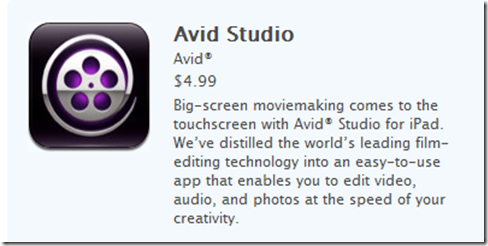
Avid for iPad is here


Avid has launched a new video editing iPad app, which it hopes will give Apple’s iMovie a run for its money, and is Avid’s first prosumer video editing app for the iPad.

avid-ipad

Avid Studio for the iPad enables you to quickly arrange your clips in the Storyboard, make precision edits using the Timeline, and add high-quality transitions, effects, and soundtracks to your movie footage.

Avid has created an app with the power of a professional editor, yet is easy enough for newcomers. It looks to be a big step up from Apple’s iMovie app, which is strictly for home hobbyists.

The Avid Studio app combines a storyboard and timeline interface, where users can arrange clips in the storyboard, then use the timeline for precise cuts. It also offers touch controls not found in the desktop, like the ability to resize and rotate titles with a gesture.

To get media to edit, users can capture video or photos within the app, import media from iTunes, or capture from a camera using the iPad Camera Connection Kit ($29).

More than a basic editor, the Avid app includes picture-in-picture effects, as well as multiple audio tracks for layering sounds. When they’re done, users can upload their creations directly to their YouTube or Facebook accounts, save them to their computers, or send them to their Avid Studio desktop program for further editing.

Other features include 3D animations, transitions, and titles; full title and graphic control; pan-and-zoom for photos; and full screen playback.

Get the Avid for iPad App now:

avid-for-ipad

Tuesday, January 31, 2012

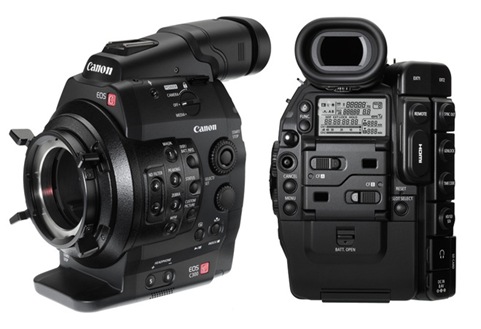
Canon C300 poised to take over Hollywood?

Canon c300 video camera

The EOS C300 – the latest Digital for Film camera from Canon – starts shipping from today. Aiming to compete directly against the Reds of the world, it carries a Super 35mm CMOS sensor capable of up to 4K resolution 1080p capture, and should be helped in large part by the company's top-shelf lenses; like the 14.5 - 60mm and 30 - 300mm. When we first learnt about C300, it was priced at a hefty $20,000. But that's no longer the case, instead it'll cost a less painful $16,000 for the body only.

Canon has always made video cameras alongside its stills cameras, and the EOS C300 is really the natural evolution of the 5DMkII.

Canon took principles of the 5D — a full-frame SLR which shoots hi-def video — and developed it into a proper movie camera. The sensor is a conservative 8.3MP, and it records 1080p video in each of the three color channels. These pixels are big, for good low-light performance, and the movies are recorded to standard CF cards.

canon c300 for tv

From there, things get very movie-techy. The C300 records in the open-source MXF (Material eXchange Format), can capture compressed MPEG2 Full HD, uses 4:2:2 color sampling and hooks up with all manner of movie accessories. In short, unless you’re a movie pro, not much of this camera will be familiar to you.
The new camera will be joined by a range of EF and PL mount lenses, and in Canon also has a 4K-capable SLR camera in the making.

Canon is counting on a wider range of offerings as digital cinema gets more serious. There’s time. The first significant all-digital movie came out a decade ago: Once Upon a Time in Mexico, where “significant” applies more to digital cinematography than to the flick. Some movies are shot with a combination of film and, for special effects, digital. Even in Hollywood, the ability to streamline production and see daily rushes without the cost and delays developing and printing film, can be an important money-saver when studios shoot all-digital.

Wednesday, August 31, 2011

How to sell your film online

Selling your film online has now became easy, although it wasn't always like this till even a couple of years back. You had websites like Revver and Turnhere, which later became redundant.


However, there is something even better now, and its completely free. The best part is that its promoted by Amazon.com, which with its vast resources has helped many self publishers of ebooks to become millionaires.
I am talking about CreateSpace.

CreateSpace provides free tools to help you self-publish and distribute your books, DVDs, CDs, video downloads and MP3s on-demand. So whether you're a filmmaker, a musician or an author, createspace is one service you should definitely try to sell your films, music and books.

Let us talk about filmmaking here. What does Createspace offer for filmmakers? Quite a bit if you ask me. For starters, here's what their DVD publishing section says:
Bring your film to market with retail-ready DVDs. We faithfully reproduce your artwork in full-color and package your discs in Amaray-style cases.
Setting up your title with us ensures your DVD remains in stock, made on-demand when customers order.

Here's some more benefits they claim:
  • Your movie becomes eligible for listing on IMDb
  • Printed with full-color, full-bleed, customizable disc and cover artwork
  • Create custom DVD menu artwork
  • Free UPC is assigned if you do not already own one
The best part is that you can sell your DVD on Amazon.com and have your eStore on it. Set the list price and start earning royalties. You can also choose Amazon Video On Demand™ as a sales channel when setting up your title to turn your film into a download. Definitely worth a try for short film makers who find it difficult to find a distribution channel.

Click here to setup a free Createspace account and start selling your film

Tuesday, October 12, 2010

Recording Audio for a Feature Film

Here are a few tips for recording audio for movies using a directional mic:

Where to point the microphone
  • Imagine that the microphone is a flashlight, with a beam projecting straight out from it.
  • Aim the imaginary beam directly at the mouth of the person who is speaking (not at their chest, not at their forehead).
  • If the mic is close to the actor you may need to adjust the angle slightly. For example, if you’re getting plosives or sybilants, adjust it upward or downward slightly... such as, angling up slightly past the mouth (toward the philtrum) or toward the chin. (If possible, aim it from in front of the actor, from above or below his or her mouth. So the mic will be pointing at the actor’s mouth, but he or she won’t be speaking directly into it. If you come in too much from the side, or miss the mouth, it may sound okay to you, but be missing some frequencies and sound tinny in the movie. If the actor is speaking directly into it, or is too close to the microphone, some consonant sounds like “s” and “p” phonetics may be distorted.)
Generally speaking, the microphone should be held as close to the actor as possible without being visible in the frame. It’s also important that the mic’s SHADOW not be in frame.

If you hear anything other than crystal clear audio during a take, let the director know. (That means, buzzing or hissing, vehicles going by, footsteps or creaking sounds when the actors are speaking, distant voices in the house, etc.) The mic picks them all up, at much higher sensitivity than the human ear, and they can make a shot unusable.

If you hear any buzzing, let the director know about it. Usually buzzing is caused by electrical interference. Make sure that if the if the microphone’s cable is near any cord with current running through it, that it crosses it at a 90 degree angle, rather than lying along side it.

Have fun making movies! The attention you pay to audio will make a big difference in the quality of your finished movie.


Nils Osmar is a Filmmaking Instructor who has worked as a fine and commercial artist, book and magazine illustrator, portraitist and cartoonist. His artwork has been published in the United States and Europe, and featured in several national magazines. In addition to his work as a visual artist, Nils has been active in Seattle's theater scene as an actor, director and playwright.

Sunday, May 31, 2009

Filmmaking popularity on the decline?

Is the popularity of filmmaking on the decline? Yes it is, according to Google trends.

The graph below shows the number of web users who have searched for the word 'filmmaking' on google. It seems less and less people are searching for the profession each year.


Another interesting statistic related to the above graph is the regions from which people are seeking information about filmmaking on the internet. Amazingly, India is at the top spot with a comfortable margin and 2 of its cities - New Delhi and Mumbai figure on the list.


As you can see, the top filmmaking city of America is Irvine, beating Los Angeles! Both are in the state of California though.

But is the filmmaking trend really going downhill? Or are people getting smarter and searching more targetted stuff like film schools, film training etc? Lets see:


As you can see above, that does not seem to be the case. Even the popularity of film schools seems to be on the decline!

Maybe people have just become more practical and instead of wasting time on the internet they are actually going out to shoot their films! Hopefully :)

Monday, June 02, 2008

Various Filmmaking Competitions

Some film-making competitions that are on and looking for participants these days:

  • Boom filmmaking competition: Run by MTV, the Boom Filmmaking Contest is open to filmmakers in UK aged between 16-25-years. It involves a nationwide series of free filmmaking workshops in which young people will learn something on how to make films, video diaries, news bulletins, reports and mini-documentaries. Boom! requires filmmakers to use Apple hardware and iLife software, including iMovie and GarageBand. Finished films are to be uploaded to MTV's website, where it will be voted on by website visitors, the most popular clips may be screened on MTV, and there's a series of awards for the very best candidates.

  • Creative World Awards: Creative World Awards is an annual international screenwriting competition. Entries are now open and run through late July 2008. The 2008 Creative World Awards have also announced the launch of a new online interactive video series debuting this week entitled, "The Business of Storytelling." In this special online video showcase, participants can view insider tips from several leading Hollywood executives, writers, directors and producers. These experts offer informative perspectives on the creative process of screenwriting as well as the business side of the filmmaking industry.

  • Film Racing: Film Racing is a USA based nationwide competition that challenges filmmakers to create original short films under extreme time constraints. Film Racing visited 13 cities on the 2007 Tour, and will be visiting 17 cities on the 2008 Tour challenging filmmakers to create short films in 24 hours. The films premiere on the big screen in theaters across the country and the top films advance to compete for thousands in cash and prizes. Visit filmracing.com for more details.
Subscribe to the Digital Filmmaking Blog by clicking here for the latest updates on filmmaking and screenwriting contests!

Tuesday, May 06, 2008

6 Provocative Filmmakers of the World

This is a must read article detailing the work of 6 controversial and provocative filmmakers praticing the craft from various parts of the world. You may find some of their work shocking, vulgar and downright disgusting. Some, would find it daring.

Depends on you!

Saturday, November 10, 2007

Readership of the Digital Filmmaking Blog

Hi dear readers,

this is a very personal post to all of you :)

You must be wondering, why is this kid updating his blog so randomly? Has he got bored...or is it writer's bloc?

Well, neither. I sure cant get bored of anything related to filmmaking - an emotion I'm sure is shared by all passionate filmmakers, film students and film buffs! As for writer's bloc, to be honest - that's an impossibility as well because all my posts aren't original (duh!)

Sometimes my stuff is 100% non-duplicate, like today! At most times, its a mash of borrowed knowledge from books and internet that I mould into presentable form and publish it here...making the language as coherent as possible. Sometimes, due to lack of time, I just copy and paste! However, whenever I do that, I make sure I attribute it to the people concerned, or link to the blog or website. Do point out if I missed someone.

This blog started off in November 2006, which obviously means...


its the first anniversary of Digital Filmmaking Blog!

So congratulations..to all of you! Yes you, the readers, who commented here, who read this blog, who e-mailed me with words of encouragement, who pointed out mistakes, filmmakers and film students, editors, cinematographers, screenwriters...I've had a varied audience. Every one doesn't comment, every one doesn't contact, and yet I'm aware that you came and read this blog. Here are some visitor stats to this blog in the last 30 days:


Well above you see a pie chart of the various different browsers (mostly FireFox and IE) used by people visiting us. Also, importantly, how actually people are getting to this blog. Well google has been kind, so we get got 71.4% people coming via search engines in the last month! Let's see something else below:

Above, the no. of people who visited us in the last 30 days from various parts of the world (only the top 10 cities during that time period).

I really feel exhilarated and triumphant when I find people from across the world, from various timezones, coming to this blog.

By now. you understand the graphic too well. I'm glad to see a good number of Mac and Linux users hitting up here! In fact, there's more Linux and Mac than Windows Vista!

I started out with this site with a sole dedication to digital filmmaking, but somehow, I could no hold on to it. We delved into various other branches of films and film technology. I hope you're not offended, coz I'm not! And now to the apology...

I do apologise for updating so randomly and making eager readers wait so long between posts. I've got a regular job at a prestigious sports channel now (since Septmeber, 2007 actually) and therefore my free time has become lesser and far between. Forgive me, and be prepared for delayed but definite updates!

And now, to the proposal...I want to make a short documentary film and have an idea in mind. Would it be feasible, if I asked for contributions (in the form of donations or share in profits, i.e. if at all its profitable) to the readers? Of course, the contributors will definitely see their names in the credits of the movie. Its just a proposal..maybe more of an experiment, if it works out, then what the heck! We'll make it more organized, with a good method of statistics and profit distribution...What say?

Thursday, August 16, 2007

Pinnacle to Introduce Video Editing and Filmmaking to Indian Schools


Pinnacle Systems Inc, a wholly owned subsidiary of Avid Technology Inc and video editing solutions provider, is set to launch an educational tool for schools in India. The company will introduce a customized programme in video editing and filmmaking called the Studio Academic Programme.

With technology including mobiles and cameras becoming an increasing part of kids lives, the programme will teach students to capture videos or still photographs and edit them to make their own home movies and albums.

In the first phase of its launch, the Academic programme will be introduced to schools in Delhi, Mumbai, Chennai, Kolkata, Hyderabad and Bangalore and will be launched in other cities in phase II. A special curriculum has been formulated to help students learn all nuances and become proficient in the art of video editing and filmmaking, informs an official release.

Using the Pinnacle Studio editing software, students can now add sound effects, put labels and re-arrange the order of the pictures or video to make their own Harry Potter movies or special birthday videos and upload them on the net to share with their friends and relatives.

More...

Thursday, July 19, 2007

CBBC Filmmaking Workshop For Kids


Are you aged 8-14 and interested in film-making? If the answer is yes the ‘CBBC me and my movie’ summer roadshow is just for you!


CBBC are offering budding young film-makers the opportunity to take part in a fun and practical based filmmaking workshop run by Cinemagic from 8th-10 August, in Craigavon and Belfast. From scriptwriting and storyboarding, to filming and editing, participants will learn all the skills needed to make a short film in a day!

As well as participating in the workshop, young people will be in with the chance to win the ‘CBBC me and my movie award’, - in association with BAFTA’- which is a special new award for films made by children at the annual Children’s BAFTAs.

The workshops which are taking place in Northern Ireland are part of a unique children’s film-making initiative- ‘CBBC me and my movie’ which inspires and enables children to make their own films and tell their own stories. ‘CBBC me and my movie’ is also providing an original 3D online space (www.bbc.co.uk/cbbc/meandmymovie) where children can engage with the experience of film-making.

More...

Filmmaking Workshop at University Of Missisippi


THE UNIVERSITY OF MISSISSIPPI ADVANCED FILMMAKING WORKSHOP


DATES: July 23-26, 2007

LOCATION: Ole Miss - Oxford Depot

WORKSHOP OVERVIEW: The intensive Advanced Filmmaking Workshop will be held at the Ole miss -Oxford Depot and other supporting locations on the University of Mississippi campus. The workshop is designed to take high school and college students, teachers and other filmmaking enthusiasts to an advanced level of understanding and training in filmmaking. At the time of registration, a detailed schedule will be sent to registrants.

ENROLLMENT ELGIBILITY: Registration is open to anyone (high school to adult) who is already equipped with a basic understanding of filmmaking and is ideal for those who have previously completed the Ole Miss "introductory level" Filmmaking Workshop.

WORKSHOP OBJECTIVES:

* Provide advanced level editing training
* Provide advanced level camera training
* Provide advanced level directing training

More...

Monday, June 25, 2007

OPM - Great Rule of Filmmaking

Cyndi Greening writes a very interesting article in her filmmaking blog on the number one rule of filmmaking - using OPM or Other People's Money! She writes:

The number one rule of independent filmmaking is always use Other People's Money (OPM), preferably a studio's money or a distributor's money. How many times did I give that lecture? Don't use your credit cards. Don't use your family's money. Don't use your friends' money. Statistics say that it is almost certain that your film will not make money; that you'll lose your friends and alienate your family.

How I love to agree with her!! She further states -

The students always argue with me during this lecture. They talk about Morgan Spurlock's film, SUPERSIZE ME. Some folks will talk about Kevin Smith's success with CLERKS.

Occasionally, someone will remember the more obscure but equally surprising Robert Townsend film, HOLLYWOOD SHUFFLE. They like to recall the miracle filmmaking stories, stories about the people who do just this sort of thing and end up with a wildly, financially-successful film. It's my job to remind them that there are THOUSANDS of filmmakers who follow that film financing path into a very dark tunnel. If a distributor or producer gets behind your film, chances are that they see an opportunity for financial success. Since they've made a whole lot more films than you, that's a good thing. If the money people don't get behind you, they may be doing you a favor in the long run. They may be saving you a lot of heartache and a lot of money.

Unfortunately, it's impossible to get distributors to fund educational projects ahead of time. They want to see the finished product to know if the story hangs together because, well, let's be honest, it's students learning by doing. They're cautious about giving money to that sort of thing

Read the full article here

Saturday, June 16, 2007

The Best Film Editing Software


Generally there are two types of systems used in professional and prosumer film editing:


Software Only
The cheaper of the two options, as the name suggests, software only solutions provide the editing program only. The advantage of software only products is definitely price, as the costs tend to rise pretty quickly the minute you start adding hardware to the bundle. Which package is best largely depends on whether you are a PC or a Mac user.

For PC users, the best all-round option is Avid Xpress Pro, however with a price-tag starting north of $1000 (for the software-only version), it can be a little out of the price range of many users. Price aside, the fact that you can edit both analogue and DV video, whilst familiarising yourself with the industry-standard Avid interface is definitely a plus.

A good alternative for price-conscious PC users is Adobe Premiere Pro. Premiere has always been the market leader for prosumer PC editing, however it's had a mixed reputation for a long time because of a range of issues (some of which are a result of Premiere and some which were limitations in earlier versions of Windows. Enter Adobe Premiere Pro, written completely from scratch by Adobe to be the "Final Cut" for PCs. It's certainly a far superior product to the previous version (6.5) and probably the best choice for PC-editing if you can't afford Avid. It will only run on Windows XP.

For Mac users, there is only one choice: Final Cut Pro. Final Cut is the main reason for Avid releasing Xpress Pro and for Adobe rewriting Premiere. It pretty much set the standard for video editing on equipment which is accessible to all.

A whole host of other, cheaper editing applications are also available for both PC and Mac (such as Ulead Media Studio Pro or Sony Vegas), however if you’re serious about your editing, you should probably only consider Avid Express Pro, Premiere Pro, or Final Cut Pro

The downside with software only solutions is render time. With most software-only solutions, you cannot see effects and transitions in real time - they must be rendered first. Depending on the power of your computer, this can take anywhere from several minutes to many hours. Premiere Pro, Final Cut Pro and Avid Xpress Pro all offer some real-time effect capabilities, but these are entirely dependent on how powerful your computer is, and generally only perform well on top-end systems.

Hardware/Software Combinations
More serious video editors should consider a hardware/software solution. This involves adding a card to your PC which provides capture facilities and also hardware-accelerated effects and transitions. Many hardware/software solutions offer real-time effects capabilities, however as you can imagine, having hardware in the bundle significantly increases the cost.

At the entry level, programs like Premiere and Media Studio are bundled with capture/render cards from people like Pinnacle, Canopus, and Matrox. Both of these programs are optimised to make use of special features found in these cards, and such packages offer many professional features at reasonable prices. Avid has also recently introduced the DNA series of external video-editing accelerators which add a pretty serious performance punch to systems using Xpress Pro.

The next step up is "badged" hardware/software solutions. With these products, you get a whole computer, optimised for video editing, and including propriety hardware for capture/render/real-time effects. The most well-known systems are those produced by Avid and Media 100. These systems use their own proprietary editing software which is optimised to work with their hardware (or specially selected hardware from third-party manufacturers). These systems are used in broadcasters and professional editing houses, and are therefore priced accordingly.

Original Article: Filmmaking.Net

Wednesday, May 23, 2007

A Realistic Film Shooting Schedule


The length of a film shoot is usually dependent on the budget. How many days can you afford to keep the cast and crew together, and pay for the rental of expensive film shooting equipment and vehicles? This restraint almost always conflicts with the amount of time a director would like to halve.


To make things worthwhile, make sure that:
- the actors are well prepared
- the staging and camerawork have been worked out,
- the shoot might not go as planned, so be prepared for adjustments to be made in the staging, the actors may require more takes, technical problems with equipment might occur, and mother nature may not be kind with weather!


So, how do directors ensure that they will have enough time?


There is no such insurance. But it is possible to draw up an informed and realistic schedule by taking into account the number of locations and the number of camera setups at each location.

Other factors to consider are the technical difficulties of scenes (dolly shots that require rehearsal), precision lighting, shooting in a public area you do not have complete control of, and the emotional weight of the scene. Actors should be given more time for the "big scenes" - the scenes that require emotional preparation or intricate staging.

Like anything in life, the more you direct, the better you get at it, and the more you can judge how much time you will need to fulfill your vision. Who said filmmaking was a piece of cake!

Wednesday, March 28, 2007

People Just Like the Sound of Movies

If you are making an independent film on a miniscule budget it is inevitable that some aspect of your movie will be compromised due to your lack of funds. The ultimate challenge for an independent filmmaker working with a shoestring budget is to some how make their movie look and sound like it deserves to be with the big boys on the film festival circuit.

While certain things have to be eliminated or kept to a minimum with a low budget film production such as special effects, makeup and lighting it is important to understand that the sound aspect of a low budget movie should never be compromised. Try sitting through a two hour movie that has a constant hum in the soundtrack and you will know what I mean. People will watch just about anything on the screen, but they will not listen to anything that assaults their sense of hearing.

The film industry began as a visual medium in which artists could be seen acting out stories on the silver screen, but in recent decades it would seem that the general movie going public is more interested in the way a movie sounds than the way it looks. Advances in sound technology have moved forward as fast as the advances in film and video technology have, but in the race for which aspect of a film people enjoy the most, sound is in the lead. Here is the proof: if you shoot a film with poor lighting, no costumes, no makeup and no special effects it is considered to be an artistic style of independent filmmaking called cinema verite. You can even scratch up the negative in the name of artistic license and people will still watch your movie. On the other hand, if you add some static noise to the soundtrack of a movie, mess up the lip sync of the dialogue or add errant sounds with no explanation then people will just think you are not an accomplished filmmaker technically. They will shun your movie.

Ever since the first sound movie, The Jazz Singer was made in 1929 on Stage 5 of the Warner Bros. lot in Hollywood the movie going public has been spoiled. They have come to expect that when they see a movie they will not only see life up on the screen but they will also hear it too. There is a certain level of technical quality they expect when they see movie. However, when it comes to hearing a movie, things are quite different: their standards for sound quality are much higher than their standards for visual quality. The eyes have a higher threshold for pain than the ears do, and the brain of a typical human being cannot handle uncomfortable noises for very long.

The sound of a movie can be either real or surreal, but it cannot be bad. A film audience will not reject flaws in the visual esthetics of a movie as easily as they will reject a film for its poor sound quality. For instance, if the dialogue tracks of actors voices are too low it brings to the attention of the audience the fact that the actors voices were recorded. This can negatively affect their suspension of disbelief which reminds them that they are watching a movie, and not experiencing real life. It will ultimately affect their opinion of the film for certain.

The sound of a movie can determine whether or not it will be a success. The Star Wars movies owe much of their success to the sound designers and technicians who worked very hard to create alien sounds that complimented the visuals perfectly. They made those movies sound believable, literally, and that is a very hard thing to do in general when it comes to science fiction films.

The tools that are necessary to record, design and mix sound for movies have made great strides in terms of advancements. Only two decades ago there were only a handful of skilled sound recorders, designers, and mixers that provided the sound for movies. This was because the equipment was very expensive to purchase. A person who wanted to do this kind of work for a living would have to invest a large amount of money to buy a vast amount of equipment that filled up a lot of space. You would usually have to rent or buy a place to set up shop. On top of that you would probably have to take classes to learn the skills of sound for films. Nowadays, things are much different.

Advances in sound technology have made everything smaller, easier to learn and definitely more affordable. A small, inexpensive digital sound recorder and microphone can now be used to record sound that is indistinguishable from sound that was recorded on a much bigger and much more expensive Nagra reel to reel sound recorder. A good digital sound recording package can be purchased for less than $1500. Also, a person can buy a home computer setup with a sound design/mixing program for under $1000. Twenty years ago you would have to spend about $20,000 to buy comparable equipment. You can even learn the necessary skills using computer program tutorials on your home computer. The best part about is the fact that you can literally do all the sound work on an independent film production entirely by yourself.

If you are planning to make an independent film and enter it in film festivals you should make sure that the sound quality is as good as the best films on the festival circuit. You cannot settle for sub-par when it comes to sound quality. If you do, your audience will notice it immediately and this will cause them to no longer suspend their disbelief. When this happens you can be sure that they will become annoyed and head for the exits.

Michael P. Connelly is an Author, Artist and award-winning Filmmaker who writes on a variety of topics that effect people in their every day lives.

Saturday, March 03, 2007

Filmmaking - What To Do Until The Money Arrives

If you are not busy making your movie, you should get busy making your movie.

“How can I start,” you whine, “when I don’t have any financing?” I know it seems you can’t roll film or tape until you have some money, but your lack of funding isn’t permanent, is it? You will have money at some future time, won’t you? You must have faith that things will get better, or they won’t.

So that’s a good place to start. Generate a little faith, and step out on it. Actively visualize how your film will look, and sound, and how it will be financially successful.

Visualization is key here. It literally costs nothing, but makes the real movie possible. I recommend the book, “Creative Visualization” by Shakti Gawain. http://snipurl.com/gr88

Ignore any negative people in your life, and drive yourself on faith that your movie will get done. Visualizing your movie may seem like a waste of time, but is one of the best uses of your time. Visualizing your movie is working on it.

A present lack of money should never keep you from working on your independent feature. Besides visualization, there are many things you can do until the money arrives.

Work on your script. Read it, then read it again, and rewrite it. Punch up the dialogue, fix the scenes, weed out weak characters, get to the point of each scene.

Your script is never perfect, it needs work. Working on it a terrific use of your time before financing arrives. Have parties, where you and your friends read it aloud, just like doing a radio play. Take note of audience response, and revise accordingly. After each revision, read it again, and again.

When funding comes through, you will know your script inside and out and upside down. You’ll know the scene numbers, without looking at the script.

Once your script is polished, start planning. Now you need to be as artistic as possible. Read your script again, with your Director hat on. Imagine what the players look and sound like. Make notes in the margins of your script, and figure out how you’re going to do it. For now, don’t even think about the money.

Once you’re sure how the movie will go together, start breaking the script down. Make lists of all the cast and crew and props and costumes and locations that you will need. Assemble your ideal team, on paper. Figure out how many special effects shots there are.

Then make up your preliminary schedule. Think through the shots and get a real understanding of how long setups and shots will take. Just because a shot only takes two sentences in the script, doesn’t mean it will only take twenty minutes to shoot.

Obviously, after you’ve broken down the script, and know what you’ll need to buy, then you make up your budget, last of all. Really think about each line item and do some research to determine realistic costs for crew and equipment. Call labs and rental houses and get rate sheets.

The good news is a practical budget and schedule and artwork will help you get financing. When you show Investor Prospects you’ve really put some thought into how the money will be spent, they’re much more likely to see it your way, and give you the money.

You might read “Secrets Of Raising Money For Your Movie,” by Sam Longoria, to learn how to gather and approach investor prospects. http://secretsofraisingmoneyforyourmovie.com

You should be using your TBF (time before financing) to network. When you call those labs and rental houses, get to know the people who work there.

Ask for names, and write them down. They’ll be good resources when the time comes, to get things at a discount. Not only can they help you on rates, but they’ll know crew wanting to break into features, who will also work at lower rates.

Join a filmmaking group. A good one is IndieTalk, http://indietalk.com It’s online, and you can reach it from anywhere. Networking with other positive filmmakers gets you moral support, and you can learn from the mistakes of others. Be selective, don’t hang with people unless they have a “can do” attitude. If you let them, individuals and whole groups can waste your time! If all they want to do is argue or debate, move along.

Pitch in! Help out on other filmmakers’ shoots, to get a better idea of how a set runs, and how long setups and shots take. This helps scheduling your own film.

By lending a hand to other filmmakers, you also make deposits at the favor bank. You will need to visit the favor bank repeatedly as you make your film, so it’s best to have an account there. If you help on their projects, it will be hard for your new filmmaker friends to deny you assistance, when you call.

Put your face before the industry. Filmmaking associations have events where industry professionals speak. Go to these. Be bold, and push through the minions and introduce yourself. Go to film festivals and be sure to attend the mixers and panels. Go to film markets, and sit in the lobby and talk to everyone.

When your financing comes through, and you have a green light to start pre-production on your film, you will already have done most of the work, just about everything but casting. Your schedule and budget will be done, you will have leads on crew and equipment, and your script will be in top form.

About the Author:

Angela Taylor is a Hollywood producer, and a seven-time Telly Award winner. She teaches Independent Producing at http://hollywoodseminars.com

Saturday, February 24, 2007

Filmmaking - What Is A Pro?


The word “Professional” is often bandied about by indy filmmakers, and I’ve heard and read many things I just wouldn’t expect a “Pro” to say, though the person writing or saying them claims to be one. Time for a definition of terms.


Question: What qualifies a person to be a Pro?

Answer: Paycheck.

That's the short answer, but anything longer is just embellishment. It's one thing to make movies. It's a whole different animal to get somebody to cut you a good check, for the work you've done.

Paycheck is more important than anything to a Professional, because you have to eat and pay bills, or you can't function, much less create pleasing Art.

Question: How does a person become a Pro?

Answer: By adopting a Pro attitude. The Pro attitude is “I work in the movie business. I do good work, and I must be paid for it.” This is regardless of the budget of his current Project, whether it is high or low.

Some don’t become a Pro until many paychecks, but you can have a Pro attitude right now, even if you’ve never been paid for doing your art. If you adopt the Pro attitude now, you multiply your effectiveness many times, and shorten the time until those paychecks come in.

A person with a Pro attitude has aligned his brain cells and unconscious mind, so every action and thought is geared toward one outcome - to be paid for his work, what his work is worth. This has many benefits, chiefly the quality of his work improves.

You can take years to get a Pro attitude, or you can do it right away. I recommend you read a book with a funny name by Stuart Lichtman, an expert on the human brain from MIT. http://snurl.com/brdr

Another great book on developing a Pro attitude is Napoleon Hill's classic "Think And Grow Rich." It’s free in the library, or get it here online. http://snurl.com/hlk4

They are both good books. Stuart’s is like a series of games, so it’s almost effortless, and it will improve every aspect of your life. Napoleon's classic book takes a while, and you have to muscle it through by will power, but it’s great.

Once you've adjusted your attitude, your unconscious mind will steer your every action and memory, every skill you have, and those you need to learn, toward delivering what you need to do your job, and be paid your paycheck.

Once you do, your natural love of your Art has a chance of being fulfilled. Until you do, you're just floundering.

You may disagree with my brutal bottom-line assessment of what a Pro is. You may feel a Pro isn't defined by a paycheck. To you a Pro might be merely a person with a lot of experience in a certain area, or a person with a natural talent.

Well, “Professional” is defined,

"Pro*fes"sion*al, n. A person who prosecutes anything professionally, or for a livelihood, and not in the character of an amateur; a professional worker." -- Webster's Revised Unabridged Dictionary,
© 1996, 1998 MICRA, Inc.

Unless he has a paycheck, his "lot of experience" just makes him a hobbyist. By definition, a hobbyist is not a Professional anything. There is nothing wrong with being a hobbyist, or an “amateur,” (which means you do something “for the love of it”), but generally, amateur quality is not up to a Pro standard.

It’s common to say, "You have so much talent, you're a real Pro," but even natural talent, practiced and refined, won’t be Pro until one’s work quality is good enough to motivate another to pay him for it.

While skill and/or talent certainly are important, the defining quality of a Professional is payment.

Think “paycheck.” May you earn many big ones.


About the Author:

Sam Longoria is a Hollywood producer, working in film since 1970, in a variety of jobs. His work graces several Oscar-nominated films, and one Oscar winner. Sam teaches Independent Producing at http://hollywoodseminars.com © 2005 Sam Longoria, All Rights Reserved. You may forward this in its entirety to anyone you wish. Hollywood Seminars, Box 2449, Hollywood CA 90078 USA

Monday, February 12, 2007

Filmmaking Cool But Not Easy


As I'm grappling with directing student film projects in the final year at my film school, I'm realizing that filmmaking is not really a piece of cake, especially when you're the director.


I have done the following projects as part of my three year filmmaking course:

* Mise En Scene (a 2 minute short without dialogue and without cuts, bg music allowed)
* Continuity (short based on the same concept as mise en scene, but this time with cuts)
* Dialogue Excercise (A 3-5 min short film with dialogues and sound)
* Music Video (My most recent project, and I dont think there's anything to explain)

Shooting all these above projects as a director, it was quite an amazing and also mind boggling experience. Its changed my whole mindset on filmmakers and filmmaking! Earlier on, I used to laugh and comment on mistakes and other faults in movies, but now I've sobered up quite a bit.

To get you a hang of what made me change as such, I must say there was an enormous pressure on my head to make my films come out well. And well, my first 2 projects (mise en scene and continuity respectively) which were quite simultaneously done, got me a good hang of this pressure. I had to face lots of problems while shooting them, which I had never quite expected:

- For one, it was a very hot afternoon with a blazing sun, and so the camera was catching an excessive amount of light - making the scene look quite burnt. Any color that came directly under the sun would just look white in the camcorder's LCD!
- Besides this, one of my actors just did not turn up. Also, he conveniently remebered to switch off his cellphone so that we could not contact him.
- Thirdly (and this was quite my mistake) , I was not able to use the crap dolly because my location floor was unsmooth in many areas. So I had to take hand-held shots for tracking movements, and obviously it did not come out very smooth.

Being the director of the film, all the above things almost deranged me that day. But now when I look back, I think it was quite a learning experience. And I've realized how important it is for a filmmaker to keep his cool in the face of adversity during a shoot.

But I am quite tense about my final project, the short film about which I've already mentioned in an earlier post. Still working on its pre-production phase.

PS: I wish I could show you my projects but we're not allowed to take them out of college until we pass out! Sad n Bad!

Sunday, January 28, 2007

Latin American Films Top Sundance Film Festival

Two Latin American films have swept awards at this year's Sundance independent film festival.


Padre Nuestro (Our Father) tells the story of an illegal immigrant from Mexico seeking his father in New York and was given the Grand Jury Prize.

Manda Bala (Send A Bullet), a film portraying the violence of modern Brazilian society, also won an award.

An Irish film has won The World Cinema Audience Award at the prestigious Film Festival.
The award was given to 'ONCE', directed by John Carney. ONCE is described as a modern day musical set on the streets of Dublin.

More than 120 films have been screened during the 10-day festival which takes place in Park City, Utah. The director of the 2007 edition of the competition, Geoffrey Gilmore, said it has been a "landmark year" for the festival.

Manda Bala, which examines corruption and crime in Brazil, was given the documentary jury's top honour.

An Israeli film entitled Sweet Mud which explores the relationship between a young boy and his mentally ill mother won the World Cinema prize.

The Audience Award for best drama was given to a film which portrays a father who must tell his children that their mother has been killed in Iraq.

The director of Grace is Gone, starring John Cusak, said he wanted to "show what really happened to bring us to this horrific state".

Charles Ferguson's film is one of which several influenced by the Iraq conflict at this year's Sundance festival.

Thanks to BBC for the above news bite

Related Posts: Film Festivals as Markets