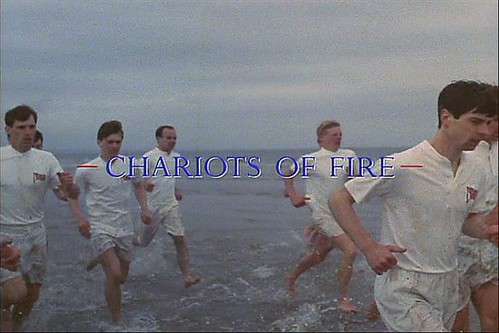
During the 1986 Academy Awards ceremony, a clip from
Chariots of Fire (1981) was shown of young men running on a beach accompanied by the sounds of feet splashing in water. Although the soundtrack may have been true to life, it was uneventful. Then the same
footage was shown with the film's famous title music. The effect was so different that viewers felt as if they were seeing different footage.. The runners gained the grace of dancers, and action became special, more than life. It illustrated the importance of sound to the creation of vibrant cinema.
In movies, sounds usually seem lifelike. However, as with visuals, what seems true to life is an illusion. If you study sound in movies, you will notice that sounds we would normally hear are often omitted or replaced by music In movies, we do not question such sounds. (yet another movie
convention). What are a few of the many ways that film sounds are created, how are film sounds often used, and, most important, how do they affect viewers? Lets check out the kinds of sounds used in films and their uses:
Spoken Words- In films, spoken words may take the form of dialogs, monologues, or narration.
- Overlapping dialogue can create or reinforce a sense of nervousness, stress, and isolation.
- Spoken words, such as those by Darth Vader, may be distorted for effect.
- Dialogue is invaluable for revealing a character’s ideas, goals, and dreams, though often it does so more concisely, obliquely, and revealingly than conversation in life does.
- Although spoken words can be extremely expressive, many films and many film scenes rely heavily on visuals and use only limited spoken words.
Sound Effects-
Sound effects consist of sounds that objects make, sounds that people make other than spoken words, and ambient sound.
-
Some of the many possible uses of sound effects are to help create a sense of location, intensify a mood, enhance a humorous situation, or conceal an action.
-
Sound effects specialists have many options in manipulating sounds, such as playing them backward, playing them faster or slower than they were recorded, constructing them, and blending them in different proportions.
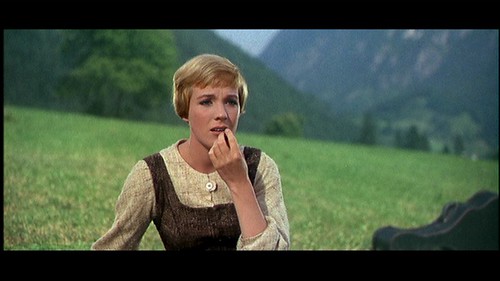
A still from the movie The Sound of Music
Music-
Film music may serve countless functions, such as to mirror a film’s central conflict, direct viewers’ attention, establish place and time, suggest what a character feels or an animal is like, and cover weak acting.
-
Film music may reference earlier film music. Sometimes the same music is used; other times an approximation is composed and used.
-
In large-budget movies, sometimes the film music is selected with an eye to future recorded music sales.
SilenceTransitions-
There are many possible ways to use sound between shots, such as to have the sound of the first shot end as the shot does.
-
Sound transitions between shots are used to reinforce continuity or contribute to discontinuity. and dreams, though often it does so more concisely, obliquely, and revealingly than conversation in life does.
Sounds in narrative films may come from on-screen or offscreen and may derive from a source in the story or outside the story.