Other techniques can be used at the editing stage to create a seamless unity for the film, whose narrative will usually contain many scenes within the story. If scenes were edited straight up against each other, then the transition from one to another could be confusing. The usual condition is to use a fade to black and a fade from black to end and begin a scene. Fades are introduced during the editing stage. Dissolves and wipes are often used too: one shot gradually gives way to another to indicate a transition, some times from one scene to another, but more often than not this is used to indicate the passing of time.
Discontinuity Editing
If most film editing can be described as continuity editing, then it is equally true that a minority of films use discontinuity editing. As the name implies, there is no smooth flow to the shots that are edited together, there is a disruption between one shot and the next. However, discontinuity editing can be used to good effect. If continuity editing principally supports the meanings residing within the shots that represent the narrative, then discontinuity editing can be regarded as producing meanings from the ways in which the shots are linked together. The shot are not necessarily unified: rather, meaning comes from the way in which the shots interact.
Montage
The best known example of discontinuity editing is montage, which was much used by Eisenstein, most famously in Battleship Potemkin (1925) in the Odessa Steps sequence. Here the shots that are edited together do not flow smoothly; instead they clash: they conflict with each other. The sequences switches, in a spatially disorientating way, between views of the Tsar are advancing troops and views of the fleeing citizens. The troops are armed, menacing and inhuman: the citizens are unarmed, vulnerable and all too human. The juxtaposition of meanings between the shots results in new meanings, produced by the viewer on seeing the montage of shots that are pieced together.
The Odessa Steps Sequence from Battleship Potemkin
It is also possible for the pace of editing to create a rhythm which itself produces
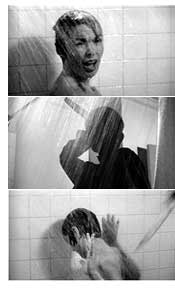 meaning. In the shower scene in Psycho there is no logical progression to the way in which the stabbing of Marion is visually presented; it is a montage of shots. The shots are short and are filmed from a variety of angles - a rhythm is set up by the editing which emphasizes the frenetic rhythm of the stabbings. The knife comes from different directions and these shots are intercut with short shots of Marion struggling. The effect of the sequence is to create a feeling of confusion, madness, panic. No doubt precisely what Hitchcock wanted.
Graphic Match
Another editing technique that can break continuity is that of linking shots containing similar visual content. The shower scene in Psycho ends with a graphic match when a camera zooms in to a close up on water swirling down the circular drain in the shower and then dissolves to a revolving close up of Marion Crane’s eyes. Shot size, movements, shapes and composition are matched.
Freeze Frame
One final film technique remains to be mentioned that is achieved at the film editing stage. The freeze frame for obvious reasons creates a discontinuity. – the moving image suddenly comes to a standstill. It is not a common technique but can be a useful device in filmmaking. In Jules et Jim (Truffaut, 1962), at one point Catherine is pretending to pose like a model. Truffaut momentarily freeze frames the shots of her poses to create the impression of a photograph.


