Ellen Kuras is one of the best-known directors of photography in American independent film of the past 20 years. She has won the Sundance Film Festival's cinematography prize three times. To list just a few of her credits, she shot Spike Lee's 4 Little Girls, Bamboozled, He Got Game and Summer of Sam, Michel Gondry's Eternal Sunshine of the Spotless Mind and his new film, Be Kind Rewind, Jonathan Demme's Neil Young: Heart of Gold and Mary Harron's I Shot Andy Warhol.
Before she ever picked up a camera, she started working as a director on her first film about a Laotian family's experiences in the United States. That was 23 years ago and now that film, Nerakhoon (The Betrayal), a gorgeous metaphoric meditation on immigrant displacement and loss, has its premiere at this year's Sundance festival.
Kuras's long-term project represents an extreme but distinct trend in documentary filmmaking toward films that take years. Festival director Geoffrey Gilmore noted at the beginning of the festival that fewer films were coming from the "professional class" of documentary makers and more from people with a personal investigation they were determined to share with the world.
Among the examples are fashion photographer Steve Sebring's Patti Smith: Dream of Life, which took a dozen years, as the director befriended the rock star and poet from the mid-nineties, in the early years of her widowhood to the present. Katrina Browne, a social worker, took nine years to research her family's history as slave traders before completing Traces of the Trade: A Story from the Deep North. One of the three Canadian entries in the official documentary competition, The Women of Brukman, by Montreal director Isaac Isitan, follows the women workers who took over a clothing factory after Argentina's economic collapse in 2001 and documents their legal and political battles for the past half-dozen years.
Read more
Showing posts with label Cinematography. Show all posts
Showing posts with label Cinematography. Show all posts
Wednesday, January 30, 2008

Wednesday, December 20, 2006
Cinematography - III

Camera Movement
Long takes usually involve camera movement of some sort, as it would be difficult to justify a long take in which the camera was static, unless the action within the frame was sufficiently interesting to be able to hold our attention. There are four main types of camera movement: in a pan shot the camera rotates horizontally around a fixed position (often used to follow movement); a tilt shot moves the camera vertically around a fixed (typically used to indicate height); a tracking shot involves a horizontal movement of the camera in which it changes location, usually fitted to a device called a dolly that runs on rails; a crane shot enables the camera to be raised and lowered and moved horizontally. In addition to the above, it is also possible to use a hand-held camera or to utilize the zoom facility, which strictly speaking is not a camera movement but movement within the camera - repositioning the lens in relation to the aperture.
The problem with hand-held camerawork is that the shots can be unsteady, but the use of steadicam equipment can overcome this problem and provide smooth moving shots. The viewer is linked more directly to the person filming; first because we usually see exactly what he sees via the camera but also because we are reminded of their presence through the shaky camerawork.

Shot taking with a crane
Crane Shot
In Martin Scorsese’s opinion, one of the greatest shots of all time is a crane shot lasting more than a minute, used by Hitchcock in Young and Innocent (1927). In this film a murder has been committed and those investigating believe the culprit is in a ballroom; the only clue that they have is that the murderer has a facial twitch. Hitchcock gives the viewer information that the investigators don’t have with a crane shot that begins with an ELS of the ballroom, and then moves over the heads of the dancers towards the band on the stage, ending with an ECU of the drummer’s face, which begins to twitch.

A Jib on Tracks
Zoom and tracking shots Camera angle provides another means of producing different meanings. Normally the camera angle is horizontal and at eye level: we usually communicate with each other at something approximating eye level and subconsciously expect to relate to the characters in films in the same way. However, high and low camera angles can be used too. A high camera angle can be useful for providing a general overview of a situation. A low camera angle may be required because of the position of a character in relation to something else. High and low camera angles can also be used to represent a power relationship between characters in a film or to emphasize the subordinate or dominant nature of a character to the audience. An angled shot can also provide a distorted view.
It will immediately be realized that a tracking shot is one way of bringing a subject closer by physically moving the camera nearer. However, another technique which produces a similar effect is that of a zoom, the main difference being that the camera does not physically move closer but the lens alters its focal length .But while both techniques bring the subject closer, they differ in how they deal with perspective concerning the relationship between shat is in the middle of the shot and what is at the edges of the frame.Camera Angle
Monday, December 18, 2006
Cinematography - II
Length of take

A still from Cinema Paradiso (1989)
If shot sizes tend to be large at the beginnings of films and scenes, an equivalent characteristic can be noted for shot duration of the length of a take. The average duration of a shot approximately 6 seconds, but introductory shots are often at least twice this length. Again, the pace tends to be slower in order to allow the viewer more time to become acquainted with characters and locations. If we look at 2 minutes from near the beginning of Cinema Paradiso (1989) we find only five shots. Within this time we are introduced to the main character Salvatore and his wife, who informs him that an old friend, Alfredo, has died. This leads into a flashback to his youth which goes on to provide his childhood memories, which constitute the bulk of the film. If we then look at a 2 minute period from the climactic section of the film, when Salvatore saves Alfredo from a fire in the village cinema, we find 52 shots. The narrative allows short takes because we know the location and characters well, and the narrative also requires short takes because the scene involves action and panic. Imagine the effect if we reversed the shot duration: 52 shots in 2 minutes to introduce characters and only five shots to cover 2 minutes of fast-moving action.
There can be other reasons for long takes in a film. Orson Welles famously and Jean Luc Goddard infamously, have used long takes. In Goddard’s Weekend (1968) one shot lasts 8 minutes and gradually reveals to us a long line of cars in a traffic jam. As well as also helping to ensure that the film is ‘alternative’, which was no doubt part of the director’s intention, the shot also helps make one of Goddard’s points about cultural life and consumerism in 1960s France-the point being that while the trend of going away for the weekend grew, it increasingly resulted in people spending the weekend in traffic jams
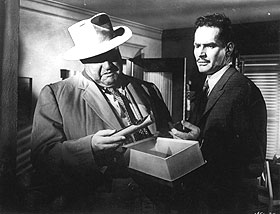 Welles began Touch of Evil (1953) with a shot lasts over 3 minutes. It begins with a close up of a bomb being planted in a car. The camera then rises to give us a bird’s eye view of the situation, including the car driving off. The camera tracks to catch up with the car, then drops down to enable us to hear a banal conversation between a border guard, a woman and a man. This technique builds suspense as we are expecting an explosion, which soon follows and brings the shot to a close. Being the exception to the rule begs the question, why use a long takes instead of editing together several shots covering the same action? It could be argued that in this instance we are given anoverview of what is happening in adjacent locations simultaneously as a way of providing us with the bigger picture. However, if this is the intention, then why is the technique not used more frequently?
 Alternatively it could be argued that such a shot was motivated more by style than by the requirements of the narrative, which is not necessarily undesirable. For now it is sufficient to note that it is a technically impressive shot with incredible complex timing which has certainly gained a place within the study of film.
Having suggested that the long take at the beginning of Touch of Evil may be more to do with style than with content. It would be wrong to assume that this is always the case.
Depth of Field
Another aspect of cinematography is the depth of field. Depending on shutter speed, aperture and the amount of light available; a camera can focus on just a small part of what is in the frame or on the whole scene. Focusing on only part of a frame is known a shallow focus and is often used as a device for encouraging the audience to concentrate on a particular part of the scene. Conversely, seeing everything in focus, from foreground to background, is known as deep field photography or deep focus.
Friday, December 15, 2006
Cinematography
As most of you must be aware, cinematography is concerned with recording the elements within the shot. While photography is the recording of a static image, cinematography is the recording of a moving image. In order to obtain the desired images, the cinematographer must attend to two areas: control of lighting and operation of the camera. The images consist of reflected light and the camera records light. Indeed, in Britain a cinematographer (the person responsible for lighting and camerawork) is sometimes known as the lighting cameraperson or as the director of photography.
Important Aspects of Cinematography
FRAMING
A key ingredient of cinematography is framing. This refers to the edges of a shot, in that framing determines both what is included and what is excluded. There is indeed a close link between framing, composition and mise en scene. Mise en scene refers to what is to be filmed and how it is arranged and therefore in effect defines what the framing will be; however, strictly speaking the framing is only realized when the shot is filmed through the camera lens.
In the Norman and Marion conevrsation scene from Alfred Hitchcock's Psycho, Hitchcock could have chosen to widen the framing so that we could se both Marion and Norman. However, this would have entailed including more height in the shot, which would perhaps have meant meaningless space and detail. The tighter framing chosen by Hitchcok means we get a mid shot of Norman's reactions as he speaks to Marion. Hitchcock nevertheless briefly gives us a long shot of both Marion and Norman at the beginning and end of the scene to provide us with a sense of spatial relationship between them.
SHOT SIZE
Shot size in turn is determined by the framing. There are many possible choices of shot but we can think in terms of five basic shot sizes with intermediate shots in between. Shot sizes can be closely tied to narrative development, notably to the progression of scenes. Typically a film, and often a scene, will begin with an extreme long shot (ELS). Just as narratives tend to begin slowly in order to acquaint us with characters and locations, so films visually use an ELS (sometimes called an establishing shot) to place things in context. An ELS allows us to see a subject in relation to her/his surroundings. Blade Runner begins with several ELSs which gradually introduce us to Los Angeles in the twenty-first century, followed by the introduction of themes and characters.
Important Aspects of Cinematography
FRAMING
A key ingredient of cinematography is framing. This refers to the edges of a shot, in that framing determines both what is included and what is excluded. There is indeed a close link between framing, composition and mise en scene. Mise en scene refers to what is to be filmed and how it is arranged and therefore in effect defines what the framing will be; however, strictly speaking the framing is only realized when the shot is filmed through the camera lens.

In the Norman and Marion conevrsation scene from Alfred Hitchcock's Psycho, Hitchcock could have chosen to widen the framing so that we could se both Marion and Norman. However, this would have entailed including more height in the shot, which would perhaps have meant meaningless space and detail. The tighter framing chosen by Hitchcok means we get a mid shot of Norman's reactions as he speaks to Marion. Hitchcock nevertheless briefly gives us a long shot of both Marion and Norman at the beginning and end of the scene to provide us with a sense of spatial relationship between them.
SHOT SIZE
Shot size in turn is determined by the framing. There are many possible choices of shot but we can think in terms of five basic shot sizes with intermediate shots in between. Shot sizes can be closely tied to narrative development, notably to the progression of scenes. Typically a film, and often a scene, will begin with an extreme long shot (ELS). Just as narratives tend to begin slowly in order to acquaint us with characters and locations, so films visually use an ELS (sometimes called an establishing shot) to place things in context. An ELS allows us to see a subject in relation to her/his surroundings. Blade Runner begins with several ELSs which gradually introduce us to Los Angeles in the twenty-first century, followed by the introduction of themes and characters.

A film can begin with an extreme close up (ECU); this could be used to make us inquisitive, or it may simply be an impressive shot because of its content, but more often than not it won’t make much sense. The Good, the Bad and the Ugly (1967) famously begins with an ELS which is immediately transformed into an ECU as a character walks into shot and looks straight to camera. The shot is interesting and intriguing while also being disconcerting; however, it makes no obvious sense in the context of the film. It does not enable us to get to know the character in greater depth, which would arguably be a pointless exercise anyway as he dies a couple of minutes later. The choice of shot seems to be more to do with style and experimentation than with illustrating the narrative. Furthermore, having a character look straight to camera is usually identified as a technique of alternative cinema.A first close up is usually found some minutes into a film when we are already accustomed to characters and locations. Typically a CU will concentrate our attention on as important detail to ensure that the desired meaning is communicated, or else a CU will be used as a reaction shot to show someone’s response to an incident. It is common to find a CU of someone’s face when their expression tells us something or a CU on an object that is to have a crucial function in the film. Scream in fact begins with a potentially confusing shot, a CU of a telephone: however, we do hear a phone ringing and we don’t have to wait long for it to take on relevance. The camera tracks back to show Casey picking up the phone. These introductory shots are also soon followed by an exterior ELS (albeit a threatening one) of Casey’s home to provide us with the context.
I will continue with this topic in the next post, discussing other aspects of cinematography...
I will continue with this topic in the next post, discussing other aspects of cinematography...
Subscribe to:
Posts (Atom)